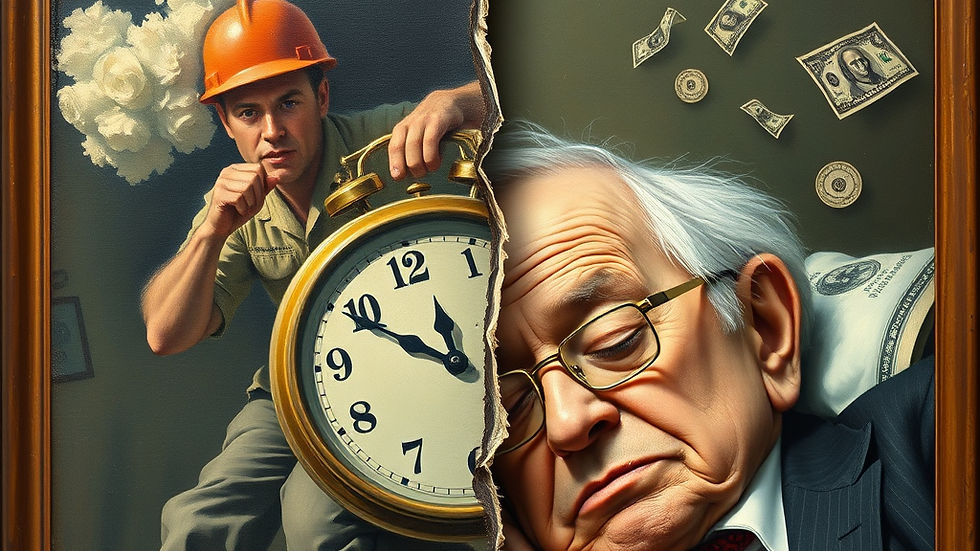
You Clock In. Capital Never Clocks Out.

There is an old Tamil proverb: “நாய் வித்த காசு குரைக்காது”. It means that the money earned by selling a dog does not bark. Once money is earned, it carries no trace of where it came from. Whether the source was moral or immoral, creative or exploitative, the money itself remains unchanged. This is one of the oldest and most honest definitions of capital. Capital has never been naturally connected to morality.
We often talk about capital as if it were a single, uniform thing. In reality, it appears in many forms. Some wealth is inherited over generations, while some is created within a single lifetime. Some capital is built through ownership of land, resources, or political power, while some emerges from ideas, technology, and innovation. There is capital that grows by collecting rent and capital that grows by taking risk. There is income earned through commissions and financial flows, and income earned through specialized, high-value labor. These forms behave differently and shape society in different ways, but once they circulate in the economy, they become indistinguishable.
As societies moved from agrarian to industrial and then to service and consumer economies, the relationship between labor and capital changed significantly. The traditional framing of labor versus capital no longer describes the tensions of the modern world. Technology, automation, and scale have altered what labor itself represents. Time, once the primary unit for measuring contribution, has lost its relevance. Ambition, Ability, and Attitude can no longer be measured by hours worked, just as institutions can no longer be evaluated only by revenue growth or cost reduction.
Labor was once the foundation of economic exchange. Everyone had time, everyone could work, and everyone could participate. Capital was never equally accessible. Today, the imbalance has become more visible. Capital now generates more capital far faster than labor can generate income, yet access to capital and the ability to earn from it remain limited to a small part of society. Even pensioners, who should logically benefit from long-term capital accumulation, rarely participate in meaningful ownership of productive assets. Labor has been democratized, but capital has not.
The proverb reminds us that capital remains silent about its origins. But in a world where capital determines opportunity, influence, and dignity, that silence has consequences. If labor, measured by a clock, is no longer the primary engine of value creation, then broader access to capital is not just a moral question, but an economic one. The present already belongs not to those who work the longest hours, but to those who own, understand, and participate in the flows of capital. Without more inclusive access, the gap between those who shape the future and those who must live within it will continue to grow.


