Clocked Wrong: From Bullshit Jobs to Rapid Prototyping

"Suitcases that cost more than the holiday," joked the officer. I laughed.
It was a Saturday. On the Swiss end of the scenic bridge over the Rhine in Kaiserstuhl, four customs officers had stopped me, well informed about Swiss shopping habits. I had paid my dues, about 25 francs on an app, and proudly popped it open as they approached.
A startup partner told me recently, after 25 years in a large IT company: "Only 20% of the IT workers actually contribute to client output. The other 80% are free riders who are needed to justify the size of the bill."
Both stories point at the same thing. David Graeber's Bullshit Jobs was my eye-opening read on this. His argument is generous and important: the free rider is not the villain. The system is. When jobs are built around flunkies, box tickers, duct tapers and taskmasters, the worker is not choosing to be pointless. They are slotted into pointlessness by design. And critically, this is not a public sector problem or a private sector problem. It is a large system problem. The government machinery spends 55%+ of GDP in Belgium, Italy, Finland and France. Both India and Switzerland sit at 29% and 33% respectively. But the private sector is no cleaner. Large corporations protect their layers just as reliably as ministries do. As Graeber pointedly observed: the higher you climb in either world, the easier it is to freeride.
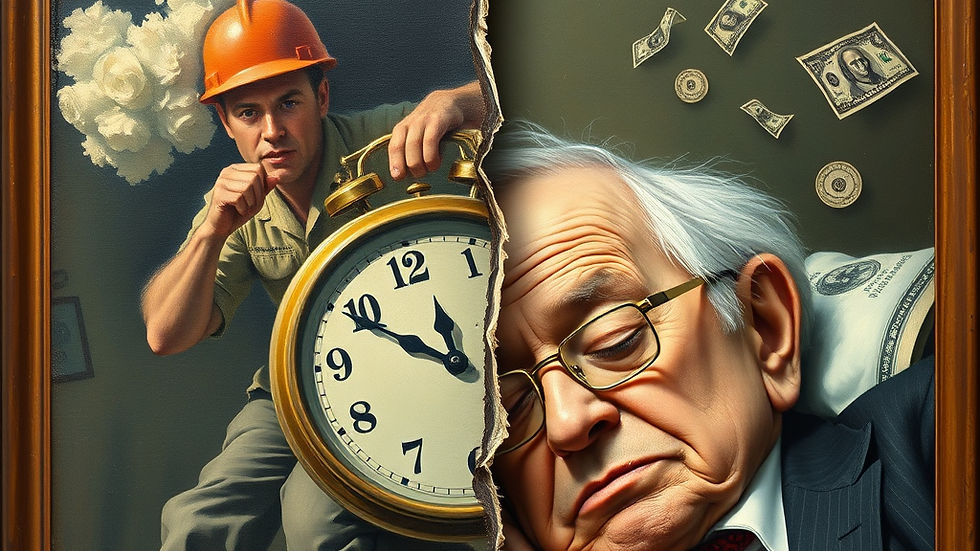
The clock is a shared fiction. You showed up. You got paid. The economy moved. The velocity of money kept the spiral going. The clock found its perfect hiding place especially in the office. Emails, virtual meetings and presentations. A full day of presence with little to nothing created. The badge was the only measure. A young person I know said they could not imagine sitting in front of a computer all day. A friend put it more bluntly: "Badging in and badging out is modern day slavery." Graeber aptly calls it psychological violence.
The clock is not universally wrong. A doctor in an emergency room cannot ignore it. Literally. But those jobs are a small fraction of the workforce. For the vast majority the clock is a comfort blanket for a system that never learned to measure what actually matters. It rewards the performance of busyness.

Automation was always available. It was deliberately aimed at useful jobs, not bullshit ones. The factory floor lost jobs to machines. The regional manager did not. Because the people who decide where automation goes are the same people whose jobs depend on the layers staying intact. What has changed since Graeber's book is the pace and the nature of what is now arriving. The cracks in the clock did not start with AI. Remote work exposed who was useful. Digital monitoring tools made the gap between attendance and output visible. Fractional talent proved you could get better results with no presence requirements. Gig platforms showed that outcomes could be priced without employment. Hockey stick valuations proved that a ten-person team with the right idea could be worth more than a ten-thousand-person organization running on the clock.
This is where Graeber's map ends and the territory gets new. Machine partners are now available to anyone willing to use them. Not as a slave like this word processor, but as a partner who searches, codes, debugs, thinks and corrects together. Code writing can be done at unimaginably high speeds. Products can be brought to market at a pace that surprises. The ones who move first are those who choose to create rather than consume, who see old problems with new eyes, who think clearly about where real value comes from.
When you unstick from the clock, something unexpected happens. You see the full landscape of what you can contribute. You might find time to plant a tree, play an instrument, help a neighbor, or build something with AI. None of these register on the clock. But all of them create real and lasting value. A tree planted today produces oxygen, shade and biodiversity for decades. We do not pay for that. Instead we distribute unemployment benefits and restrict asylum seekers from working because we fear they might take jobs from vulnerable locals. The clock does not just measure labor poorly. It allocates human contribution poorly.
New entrants and those starting over have no choice but to embrace this world. The rest may feel untouched for now, beyond a fancier presentation or a well-written report.
When I find Graeber's diagnosis worthwhile, the universal income is an idea only for those who can self-motivate, self-regulate and manage time intelligently. For others, maybe a bullshit job with some structure is a better way to be paid than universal income. Neither answer is clean.
When you remove the clock from collaboration, you need something to replace it. Not a new universal unit imposed from above. The Ubers of the world have shown where that leads. Something that emerges from the team or community itself. Trees per team in one place. Users helped in another. Neighbors supported in a third. Decentralized units of value, owned by the people creating them.
The clock, for all its flaws, was reliable. The paycheck showed up every month.
So the question is not whether the clock is broken. It clearly is. Graeber asked it first. The question now is: how do we support livelihoods and meaning while freeing people from it? And can machine partnerships get us there faster than we think?
Nobody has fully answered that yet. But building is how we find out.